
Clearing Away the Biblical Vs ‘Social’ Justice Confusion: Widening the Divide Between Christian Civic Duty & “Social Justice”
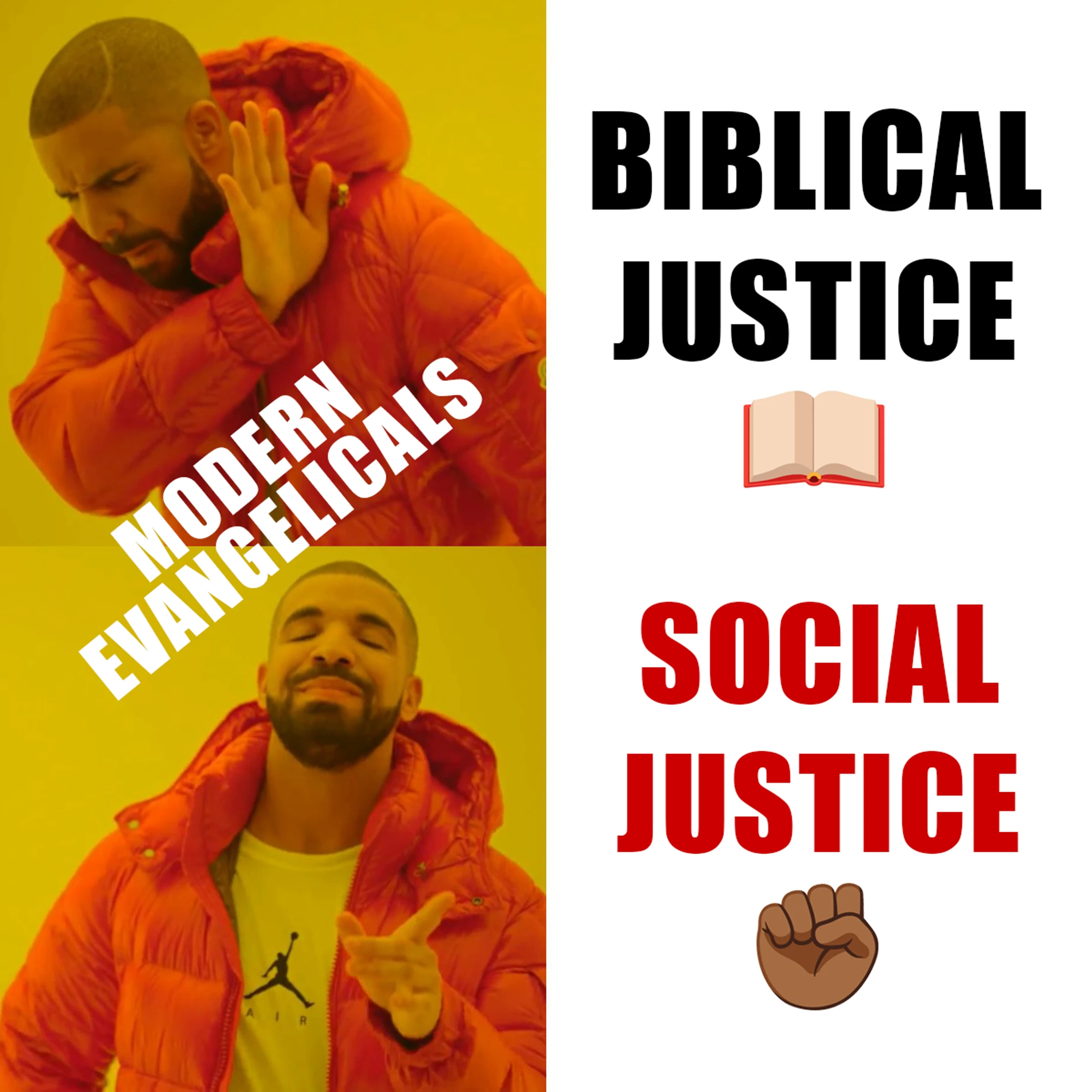
Many harbor an unspoken, unchallenged objection to engaging in politics. That silent objection goes something like this: “If I or my church start engaging politically, won’t we be guilty of becoming social justice warriors? Will I not be any different from the woke activists that push CRT and DEI in the church?”
I first heard this objection from a close friend, who explicitly opposed my biblical arguments for social and political activism on the grounds of this premise. At the time, I recall being somewhat confused and appalled that he would draw such a parallel. However, after much prayer, research, and study, I now see that it is not entirely unjustified for those who have never thought deeply about these issues to draw the parallel between ‘social justice’ and biblical social action. Let me explain.
Overreaction as the ‘Solution’: Losing Our Political Theology Heritage
When our country was founded, the issues of political theology were so raw for everyone that even to suggest that an intelligent person had not thought deeply about social action, politics, and the relation between the church and state was laughable. It’s not an overstatement to say that our country was founded as a response to the historic controversy over political theology and how to apply that in practice so that freedom of conscience and the Christian’s religious liberty would be preserved.1 The founders met with success in that endeavor, at least more success than had ever been seen in the history of the world. Thus, America became the ‘new world’ where freedom and opportunity flourished.
However, there are outstanding responsibilities that come with creating such a profound experimental society, and in turn, significant consequences when those responsibilities are not taken seriously. I do not doubt that many generations tried valiantly to preserve the lessons of our founding era; however, several generations arose who no longer cared to remember or respect the founding ideals, much as in Israel’s history (Judges 2:10). A significant change occurred in the generations that fought the world wars, turning to worldly consensus rather than biblical solutions.2 What resulted was a pluralistic society, which is a civil form of polytheism.
What took place in the church was similar but more consequential. The theological liberal movement of the 19th century had a profound influence on both broader society and the church before the world wars.3 This influence pushed for social action at the expense of sound doctrine, and in response, the more conservative branch of the churches pushed back. Sadly, they responded so forcefully that many in the conservative Christian churches disengaged from social action altogether, retreating to a sort of monastical pietism and eventually baking that into their new tradition.4 They treated the real danger of distorting public responsibility (by creating an idol out of it) as absolute. They retreated to their churches, abandoning both their long-recognized biblical responsibility in the public sphere and the tradition of political theology that accompanied it.
While some attempts were made by individuals like Carl F. Henry and Bill Graham to preserve the heritage of conservative social action, they ultimately failed to convince fundamentalists to join them in their neo-evangelical project.5 Thus, the only ones listening and participating in that attempt ended up being the theological liberals of various degrees, who took advantage of their weakness, which a critic described as “ultimately one of assimilation, and in the end… no more than capitulation to the dominant culture.”6 This was a tragic nail in the coffin of a dominant social ethic for conservative thought in the 20th century.
This brings us closer to our current context. We now live nearly one hundred years downstream of that failed attempt to preserve a biblical social ethic, and the fundamentalist tradition that marked itself by political retreat and a muted political theology. We’re a little less than one hundred years from the PTSD-type reaction to the world wars, often described as the pluralistic “post-war consensus.” And where has that gotten us? Satan’s forces have rushed into the vacuum that conservative Christians left and have done an outstanding job of taking a dominant influence over our once biblically influenced constitutional republic. Yet Satan wasn’t content with simply flooding the public square; he wanted our churches as well. Thus, the recent woke Christian movement was born.7
An Open Door to the Perfect Trojan Horse: Woke ‘Justice’ Fills the Void
Shortly before the watershed moment of the COVID era, a fault line began splitting the more conservative evangelical world. Evangelical leaders held several conferences, such as MLK50 and T4G in April of 2018, where supposedly conservative voices began decrying ‘systemic racism’ in the church and the need for ‘racial reconciliation.’8 This divide struck the church hard and had a sort of backhanded effect on many, who did not know where in the world the sympathy for this movement was coming from. However, one thing was clear: ironically, most evangelicals did not have clarity on whether this movement should be opposed or embraced. Jon Harris writes that though these movements often “undermined Christian understandings of sexual ethics, revelation, [biblical] justice, and the universality of sin… Still, many Christians supported the movement. The New Yorker ran a story entitled, ‘How Black Lives Matter Is Changing the Church’ in the late summer of 2020. The author described how the movement ‘prompted a crisis of moral conscience’ for ‘evangelical and mainstream churches.’… Pastors marched with protestors, accepted rebukes from black peers, and started receiving black ministry leaders in mostly white evangelical circles.”9 Rather than fight racism, though, these leaders and Christians who participated in these events ironically were participating in the newest iteration of systemic racism (affirmative action)—such is the deceitfulness of sin.
In response, more stalwart conservative pastors, such as John MacArthur and Voddie Baucham, spoke out against this movement even as it was gaining momentum. John MacArthur stated that he believed the social justice ‘gospel’ was “the most subtle and dangerous threat so far” to the church.10 Voddie wrote a book addressing the threat and worked with other pastors and theologians to form The Dallas Statement on Social Justice & the Gospel.11 However, as Jon Harris lamented, “these efforts failed to impact the majority of mainstream evangelical leaders.”12 But why? Why did these efforts largely fail? And why were so many Christians left without much clarity about the danger of this movement? Why does this movement in the church still have traction today, even though both Christian and non-Christian conservative voices have tried to draw the battle lines? In asking these questions, we are now getting to the heart of the problem.
Shortly thereafter, the Christian Nationalist response entered. Though the term ‘Christian Nationalist’ (CN) had started as a term of derision to ridicule politically active conservatives who may or may not be Christians (but more often are associated with the Trump/MAGA movement), it was later embraced by several pastors and Christian leaders.13 There is, admittedly, a wide variation among those who embrace the label.14 On the one hand, because some individuals in the CN movement hold unorthodox views, others who might otherwise fit the label are wary of it for that reason.15 On the other hand, the theological liberals and secularists who use the label as a mark of derision apply it to nearly any Christian who expresses conservative, historic orthodox views of family, church, and society. So you will likely be labeled ‘Christian Nationalist’ if you hold to conservative orthodoxy to one degree or another, whether you like it or not, and whether you embrace it or not. However, it is more accurate to apply the label to those who have a cogent political theology that recognizes both their explicit and providential responsibilities in the civil sphere.
Unfortunately, many in the larger evangelical world have a ‘Stockholm syndrome Christianity’ problem: they either ignore or belittle the CN movement, treating as unbiblical or its own unique error, and they do this because the theological liberals (who are politically liberal or leftist) set the ground rules for them, whether they are aware of it or not (especially concerning political theology).16 So, while the CN movement slowly grows in the shadow of ‘Big Eva’ and gains traction over time, it still lacks a prominent voice in the larger evangelical world. This only exacerbates the real problem, though.
Addressing the Confusion: Clearing Out Counterfeit ‘Justice’
While there’s much more that can be said, and perhaps an entire book’s worth of research could be done, what I have covered so far for our present topic should suffice. The conflation of ‘social justice’ with biblical social action is a profound confusion that requires clarification and answers. Thus, the historical-theological survey just given provides two critical points: (1) the biblical model for social action and civic duty taught in conservative churches was abandoned, and (2) the liberal-theological tradition filled that void over time, but especially in the recent woke insurgence in the more reformed and conservative churches. This is important because where there is no clear teaching provided, error or confusion will take its place. Similarly, where there is no positive political theology taught, there is at best a negative political theology (such as a non-resistance or passivist viewpoint), and at worst, a gaping hole that manifests guilt-laden sympathy for any outside political theology that comes in using bible verses to support it, even if those verses are misused.17 Therefore, you should now begin to see why the ‘social justice’ movement has gained such prominence in recent years, and why confusion arises among those who hear other Christians, such as some who identify with the CN response, and become concerned that they are merely doing the same thing in a slightly different way.
In response, it must be clarified that the ‘social justice’ brand of ‘justice’ becomes clearly counterfeit when held up next to a robust biblical vision of social action and political theory. Those who lack that robust biblical understanding of justice will have nothing to compare it to. Since justice in biblical terms necessarily encompasses both the state’s role and the individual’s engagement in the broader society, one must start by clearly defining these areas.
Ever since the conservative retreat from social action, much of this study (if it has been done at all) has been confined to the area of ethics rather than systematics. And while to some degree that could be justified, we don’t see that being the case in the divines of old. Consider The Westminster Confession, which is a confession of doctrine (not an ethics textbook). In section “XXIII. Of the Civil Magistrate,” where it speaks of a political ruler’s role, the confession declares that Christians can and should accept that role, and that regardless of whether it is a Christian a ruler or not, that the Christian must “pray for… honor… pay them tribute and other dues… [and] obey their lawful commands”—the key here is the word “lawful,” it was plainly understood that rulers must abide by God’s definition of right and wrong, good and evil.18 Wilhelmus A. Brakel in his works titled The Christian’s Reasonable Service, under the chapter heading “Love for One’s Neighbor,” lists the “specific deeds thereby this love is executed” and says, “As far as the body is concerned, we are to feed the hungry, give drink to those who are athirst, clothe the naked, visit the sick, give lodging to the stranger, help someone in whatever perplexity he may be, and support him by counsel and in deed (Matt. 25:35-36). That is the labor of love referred to in 1 Thessalonians 1:3.”19 In volume 3, Brakel even teaches through the Ten Commandments and the duties of Christians therein. John Calvin spent most of the fourth book of his Institutes of the Christian Religion addressing the role of government in relation to the church. I provide these examples before we continue because it is necessary to acknowledge that there was a time when it was not unusual for pastors and theologians to address these issues in the church.
If we then compare a biblical vision of justice to that of the ‘social’ vision of justice, the argument for the difference and the division of duties ought to be made clear. The social justice model (SJM), in its purest form, even in the original Liberation-Theologian models, incorporates Darwinian and Marxist assumptions through the back door, imbuing Christian terms with new meaning.20 Thus, it is best to compare the purest secular form of SJM for the sharpest contrast to the biblical justice model (BJM). All ‘Christianized’ versions of the SJM will have, to one degree or another, non-biblical assumptions that are taken from SJM’s Marxist-Humanist roots.21 Keep in mind, these are summaries and generalizations, simply for the sake of comparison. Below is a chart that provides a contrast between the two.
While more could be included in this table, these should suffice for illustrating the stark differences between ‘social justice’ sourced in the world and true justice from God’s word. The differences are so stark that it might, at first glance, seem foolish to think there would be any confusion between the two. However, the subtlety comes with two caveats: first, those who bring it into the church often do it incrementally, importing only select aspects of the SJM at a time; second, as stated earlier, the BJM has not been clearly defined in most of modern churches due to residing so long in a peacetime environment and the historical retreat of conservatives.
Once again, there is much more that could be included in these comparisons, but what should be noticeable in what has been provided is the explicit biblical nature of the BJM in contrast to the SJM. On the one hand, any Christian pushing for social action who is truly basing it on God’s holy word is not asserting anything that can be proven sinful from that same standard. On the other hand, the SJM, time and again, has been exposed for redefining good and evil in outlining its social duties, making virtues out of sins. That is, in fact, the crux of the issue. I was reminded of this just yesterday as I was engaging in door-to-door evangelism, where I encountered a woman who lectured me for being a terrible Christian because I didn’t support socialism, LGBTQIA, abortion, and illegal immigration—she explicitly said a faithful Christian would “vote Democrat”—because she had been taught good is evil and evil is good by SJM advocates in theologically liberal “churches.”
Ultimately, though, the SJM is almost always tainted by future visions of accomplishing what only God can achieve in human history. Consider the seminal liberation theologian, Walter Rauschenbusch. He was a paradigmatic figure among them and is credited with the statement, “The kingdom of God is not a matter of getting individuals to heaven, but of transforming the life on earth into the harmony of heaven.”22 This really sums up the goals of any SJM; whether it holds every feature above or not, it seeks to impose expectations upon humans that are only possible by divine intervention. The BJM model never does this, not even its orthodox postmillennial forms.23 Ultimately, for the BJM, it comes down to a faithful application of God’s prescribed will for society in a fallen world and His prescribed will for each Christian and non-Christian, regardless of one’s beliefs about the future. It really does come down to the issue of God’s expectations of men, especially the redeemed, right now. And that cannot be understood apart from sphere sovereignty and God’s law, both of which are often sorely misunderstood among evangelicals.
Why God’s Law & Sphere Sovereignty Are Non-negotiable: Biblical Justice Defined
God’s law is not a boogeyman that you need to fight every time it pops up. The law is good and righteous, and it is so for its intended purpose (Rom 3:31; 7:12).24 The primary reason we have so many negative statements by the Apostle Paul concerning the law is due to erroneous attempts to misuse it, specifically using it to obtain salvation, which God never intended the law for during any stage of history. When the Jews tried to use it (or keep it) to obtain salvation, it became a “yoke” which they were never “able to bear” (Acts 15:10). Paul said that they pursued “a law of righteousness” but could “not attain that law… because they did not pursue it by faith, but as though it were by works” (Rom 9:31-32). Many Christians, at this point, might retort, “But Paul also says that I’m not under the law any longer!”—yes, but what is meant by that? Not that the law is abolished, Jesus promised that would never happen (Matt. 5:18-19); instead, Paul implies that the law no longer has the condemning power it once had because of one’s union with Christ (Rom. 6:14-15). The relevance of the law for every image-bearer will not pass away “until all is accomplished”; this is because sin remains a problem for even the redeemed in Christ until glorification (Matt 5:18). The question isn’t whether the law relates to you, but how it relates to you.
Paul taught that “the Law is good, if one uses it lawfully” (1 Tim 1:8-11). How then do you use the law lawfully? By applying it in its three uses. The first use is the civil or political use for the restraint of outward sin and to preserve order in society, because sinners need threats of punishment, whether redeemed or otherwise, which are effective due to the work of the law written on the hearts of men universally (1 Tim 1:8-11; Rom 2:15; 13:3-4). Second, there is the evangelical use, where God’s law is employed as a “tutor” that warns a person of their violations and impending condemnation, leaving them without hope apart from Christ (Gal 3:24-25). This use is also described as a “mirror,” as James illustrates in 1:23-24. Lastly, the third use is the normative or didactic use of the law, set as a guide for Christians in godly living, as a light that guides the path of righteousness, which is pleasing to the Lord (Ps 119:105; Rom 7:22). For Christ says to His redeemed people, “if you love me, you will keep my commandments” (John 14:15). These uses of the law should not be controversial nor difficult to understand. Every Christian should have each use of the law memorized; this should be a fundamental part of discipleship in the church.
When a community learns and loves God’s law, it will begin to spot the problems with SJM, whether explicit or subtle. They will see that socialism (along with every socialistic policy) is theft and a denial of God’s gift of stewardship, which will encourage laziness, destroy incentive, and eliminate innovation. When God’s law is taught and lived, men will see that life is precious, and it must be protected by outlawing murder of the innocent (abortion) and that executing those who forfeit their own life by committing premeditated murder is just (Gen 9:5-6). They will see that sexuality is a gift from God, causing them to reject gender confusion and the mutilation of healthy bodies (Gen 1:27; 2:23-24; Matt 19:4). They will, in turn, love the family, God’s archetype for society, and reject sexual perversions like homosexuality, which destroy families, thus deteriorating society (Rom 1:26-27). Those who study God’s law will reject pacifism and embrace just war, self-defense, and defy (and even revolt against) tyranny when necessary.25 These are just a few examples of how the understanding and love of God’s law benefits everyone (Ps 119:159-160; 174-176).
In addition, understanding the proper limits and overlaps of each institution that God has ordained is also necessary for every Christian to rightly engage in society (i.e., the doctrine of sphere sovereignty). The BJM holds that certain institutions are prescribed by God, such as family, church, and ‘state’ (Genesis 2:23-24; 9:5-6; Matt 16:18; Rom 13:1-7). All institutions flow from the family, and it is the archetype of both the church and state. Each has its own authority, which has degrees and limits; each operates independently and co-dependently to varying degrees; each must work for the good of the other and respect the independence and limits of the other. God defines evil in His law and expects men to implement justice based upon good and evil as He has defined it (Matt 5:18-19; Rom 13:3). Evil comes from both internal and outward sin against God, but the state only deals with sins that manifest outwardly, affect others in the community, and are defined as crimes (Gen 9:5-6; Ex 20:3-17; Rom 12:17-21; 13:1-7). The family is designed to train people from a young age in the fear and admonition of God, but if there is anyone who fails to be governed by God’s word internally and breaks out into open scandal, the church is there to help the family with certain scandalous sins, and the state is there to punish criminal sins. God recognizes both the consent of the governed and the right of the magistrate to rule, both have duties to one another and are held in check by one another, and all are accountable to God for their actions (Deut 7:14-20; 1 Sam 8:4-22; Matt 14:3-4; John 19:11; Acts 5:29; Rom 13:1-7).
Conclusion: Reject the Confusion, Embrace Biblical Political Theory
We must reject this psyop (psychological operation) on Christians that imposes this dichotomy between religion and politics, as Chris LeDuc has described it.26 There is no dichotomy; both are essential to understand for life and godliness. Both should be taught from the pulpit—that is, the principles that Scripture teaches for Christians to know how to operate and engage in the public square. Someone will enforce their morality in public, and Christians should be ready and even excited to take the truth they possess and apply it to every area of life, especially in the public square. Why? Because Christ is King of kings, He possesses authority over all, and He expects His people to shine the light of both His word and law wherever they have influence. There is no unity or parallel between the SJM and BJM; both are opposed.
The question that comes to mind, though, is what should we expect from pastors? We should expect courage and boldness. We should see pastors proclaiming theological clarity and exhortations to stand against error and fight for the truth even in the political arena. But the expectation will sadly be far different from what we will more often find, which is sympathy for the theologically liberal and leftist political views because many have been muzzled and tamed by institutions whose foundations are infused with such assumptions. Michael Clary has provided a razor-sharp assessment of the problem in his recent article titled “Charlie Kirk and the Cognitive Dissonance of Christian Elites.”27 Clary, speaking of the training he received, said he “felt handcuffed. [He] could thunder about God’s love and the lavish grace of Christ, but whenever [he] called out abortion, homosexuality, or wokeness, [he’d] be accused of not ‘preaching the gospel.’” This is precisely how I felt for so long because I had been trained by church leaders and podcasters who fit nicely into the mold of a ‘non-offensive ministry model’ for cultural engagement. Clary says that once he realized what had happened to him, he “made a deliberate choice to reject that approach,” which took “a couple of years to fully deprogram” and retrain himself “to be bolder and more outspoken.” The ‘non-offensive’ approach only assists and emboldens the social justice warriors, so it must be rejected. As opportunities arise, challenge pastors’ assumptions, encourage them to take a stand where they are failing, and seek to sharpen, not bludgeon them.
Christians, whether you are a church leader or not, you are called to speak God’s truth to everyone. God’s law must be included in a gospel witness because, without His law, there is no identifying the problem. We must be bold to proclaim God’s law in private and in public, in homes and in the halls of Capitol buildings. And until we do, confusion will remain, and the Satanic lies of ‘social justice’ in Neo-Marxism and Critical Theory will continue to reign as it consumes image-bearers, body and soul alike.
[For a printable version of this article, click here.]
References:
- “Congress shall make no law respecting an establishment of religion, or prohibiting the free exercise thereof,” from The Bill of Rights: A Transcription, https://www.archives.gov/founding-docs/bill-of-rights-transcript, accessed October 28, 2025; Thomas Jefforson asserted that there ought to be “a wall of separation between Church and State,” James Madison argued that “religion… can be directed only by reason and conviction, not by force or violence,” Thomas Jefferson assured that “no man shall be compelled to frequent or support any religious worship, place or ministry whatsoever,” and George Washington declared “to bigotry no sanction, to persecution no assistance,” all statements that demonstrated their resolve to create a country free of the religiously coerced tyranny common in Europe at that time.
- “The postwar reconstruction of the West, they believed, required not the old pieties and time-honored truths but an entirely new mentality, one immune from the temptation of dogmas of any sort. So skepticism took priority over belief, the spirit of suspicion and critique over faith and piety… The true threats were now seen to be the strong truth-claims, metaphysical formulations and appeals to the transcendent,” R. R. Reno in Return of the Strong Gods: Nationalism, Populism, and the Future of the West (Regnery Gateway: Washington, D. C., 2019), 29.
- I stumbled on this issue reading Martin Lloyd-Jones’ commentary on Romans 13, which demonstrated that the influence of the ‘social justice’ movement by theological liberals from the 19th to 20th centuries was international (see chapters 3-5).
- “‘The Uneasy Conscience of Modern Fundamentalism’ by Carl F. H. Henry examines the struggle within Protestant denominations during the early twentieth century between Fundamentalists, who view the Bible as the definitive word of God, and Liberals, who interpret it more as a human perspective on divinity. This division resulted in Fundamentalists retreating to individualistic concerns as Liberals dominated mainstream denominations by emphasizing social issues. Henry critiques this retreat, arguing that Fundamentalism has largely abandoned its heritage of social engagement and has failed to address critical societal issues like warfare, racism, and economic injustice,” a summary by Charles White of Carl F. H. Henry’s work titled The Uneasy Conscience of Modern Fundamentalism (first published by Grand Rapids, Mich.: Wm. B. Eerdmans, 1947), https://www.ebsco.com/research-starters/literature-and-writing/uneasy-conscience-modern-fundamentalism-carl-f-h-henry, accessed October 28, 2025.
- For some of the history of this see Making Christ Known: Historic Mission Documents from the Lausanne Movement, 1974–1989, ed. John Stott, Eerdmans: Grand Rapids, MI, 1996.
- Stanley Hauerwas, A Community of Character: Toward a Constructive Christian Social Ethic (University of Notre Dame Press: Notre Dame, IN, 1991), (Page number not given, sourced here under “Critical Assessments”: https://en.wikipedia.org/wiki/Carl_F._H._Henry, accessed October 30, 2025).
- See Jon Harris’ book, Christianity and Social Justice: Religions and Conflict, for a very thorough treatment of the woke influence on the modern church.
- For messages by the MLK50 conference, see https://www.thegospelcoalition.org/conference/mlk50/ where Matt Chandler and John Piper spoke; for T4G 2018, see Ligon Duncan’s message (https://t4g.org/resources/ligon-duncan/the-whole-in-our-holiness/) and David Platt’s (https://t4g.org/resources/david-platt/let-justice-roll-like-waters-racism-need-repentance/).
- Jon Harris, Christianity and Social Justice: Religions in Conflict (Reformation Zion Publishing: Ann Arbor, Michigan, 2021), 36.
- John MacArthur, “On ‘Social Justice’ and the Gospel” at Grace To You, https://www.gty.org/articles/45SJ/on-social-justice-and-the-gospel, accessed October 28, 2025.
- Voddie Baucham, Fault Lines, Salem Books: Washington D. C., 2021. For the statement, see https://statementonsocialjustice.com/, accessed October 28, 2025.
- Harris, Christianity and Social Justice, 38.
- Leftists prefer the label “White Christian Nationalist” best, per the social justice/critical theory lens they wear; see Rev. Dr. Liz Theoharis, “How do we Confront White Christian Nationalism?”, The Nation, January 19, 2022, https://www.thenation.com/article/society/christian-nationalism-trump/, accessed October 30, 2025.
- See Andy Naselli, “Twelve Reflections on Twelve Interviews on Christian Nationalism”, Christ Over All, November 27, 2023, https://christoverall.com/article/longform/twelve-reflections-on-david-schrocks-twelve-interviews-on-christian-nationalism/.
- Founders Ministries did a Christian Nationalism pre-conference addressing the controversy around the term, you can find the three sessions here: https://youtube.com/playlist?list=PLXMbCWFEKybKaXsg8_cM3jf4xW7nQs4yx&si=bVdvQho-6KAAH-iL; Voddie appeared to embrace the term so long as he was the one defining it—in an interview with Allie Beth Stuckey, he said, “[If] you just stop and think about it for a moment, if you don’t want Christian Nationalism, what other kind of nationalism do you want? Right. Do you want, you know, secular nationalism, Muslim nationalism, you know. Or if it’s not the Christianity that’s the problem, is it the nationalism that’s the problem? If we don’t want nationalism, what do we want? Do we want globalism? You know, no thank you please… and you know what, it does sound like a bunch of scary Christian Nationalism, and so what,” from “‘Christian Nationalism’ Sure Beats Progressive Globalism | Guest: Dr. Voddie Baucham | Ep 696”, Relatable, October 24, 2022, https://www.youtube.com/watch?v=otGF0e05QVk, accessed October 30, 2025.
- See John G. West, Stockholm Syndrome Christianity: Why Christian Leaders Are Failing – and What We Can Do About It, Discovery Institute Press: Seattle, 2025. West’s thesis is an explanation for the collapsing culture which is directly tied to Christians identifying more with “secular elites than with their fellow believers”—this is true not only for all the theological categories he covers in his book, but regarding the more theologically conservative circles, it is especially true in the category of political theology.
- Guilt-laden sympathy because a true Christian will sense something missing, even if he doesn’t know what it is. Outside political theology referring to ‘social justice’ and critical theory models. Notice that even many of the conservative pastors lacked a negative political theology during COVID (what biblical basis is there to react to a social crisis?), and it was only those who did the research or simply acted upon impulse and later dug into Scripture to justify their actions that stood up to the government tyranny, opening their churches; I say this not to demean, but simply to make the observation—I was just as bereft of a negative or positive political theology at the time, floating in mid-air, as it seemed, wondering what my theological training had to say about the situation (it said little, if anything).
- See https://thewestminsterstandard.org/the-westminster-confession/.
- Wilhelmus A. Brakel, The Christian's Reasonable Service, trans. Bartel Elshout, ed. Joel R. Beeke, Vol. 4 (Reformation Heritage Books: Grand Rapids, MI, 1995), 57.
- To get a full picture of the SJM and understand CRT, the following books are helpful: Jon Harris, Christianity and Social Justice, and Social Justice Goes to Church—Harris by far brings the most ‘receipts’ to prove his points, with a vast array of references and quotes; Voddie Baucham, Fault Lines—this is simple, personal, and pastoral, best for the average church goer; Darrell Harrison & Virgil Walker, Just Thinking: About Ethnicity—a lot of well researched content summarized and ordered from their podcast; AD Robles, Social Justice Pharisees—very clear breakdown and key quotes from certain pastors trying to synchronize SJM with Christianity; Tom Ascol, Voddie Baucham, Timon Cline, Mark Coppenger, Jared Longshore, Tom Nettles, & Chad Vegas, By What Standard?—this was a very early critique of the modern SJM; David Schrock, Dividing the Faithful—this is outstanding in identifying the early insurgency of SJM into churches through a book titled Divided by Faith, it summarizes and critiques that book.
- Rarely does anyone simply invent their own ideas and import them, they are taught by others’ competing worldviews and whether they are aware of the roots or not, such ideas originated in men deriving them from the flesh and Satanic forces.
- See https://people.bu.edu/wwildman/bce/rauschenbusch.htm, accessed November 1, 2025.
- If we want to rightly represent our postmillennial brothers, we need to recognize they look forward not to “heaven on earth” but a future where the whole world, while it remains under the curse of Adam, becomes overwhelmingly Christianized. They would say it is still far from perfection until Christ returns. I include the qualification of “orthodox” because in this statement, I’m not including the unorthodox version of postmillennialism which comes from the New Apostolic Reformation (NAR).
- What I mean by God’s law is the principled truths that endure regardless of covenant or dispensation. Some divide the law into three parts; I think that’s unnecessary, and there are problems with that. What Paul says in 1 Corinthians 9:20-21 is vital for understanding the law’s relevance for every image-bearer. He gives three categories: the Mosaic Law, the “law of God,” and the “law of Christ”. Coordinately, he provides three categories of men, those “under” the Mosaic Law, those not “under” it (under Christ’s instead), and those “without law”. Thus, you can easily place the appropriate men under each: unsaved Jews under the Mosaic, unsaved Gentiles without the Mosaic but under God’s principled law (the work thereof written on their hearts; also known as natural law), and Christians under Christ’s law (which is a form of God’s law). God’s law remains valid for the believer, precisely because Paul says he is “not being without the law of God but under the law of Christ”; by that statement, he cannot mean anything other than Christ’s law carries over God’s law, without the condemnation. It’s both the condemning power and the covenants that determine which category one falls into. Gentiles are condemned by God’s principled law (natural law) both by being part of creation (the Noahic Covenant) and inheriting Adam’s guilt, who violated the Edenic administration (which could also be considered a covenant of sorts). Suppose one studies the ten commandments in accordance with Genesis. In that case, one will find that those laws were written into the threads of creation itself, so writing them on tablets at Sinai didn’t make the laws suddenly appear; instead, it made natural law (God’s principled law) more explicit.
- Pacifism is often embraced by a twisting of Jesus’ teaching from the Sermon on the Mount, where Jesus tells individual Christians to turn the other cheek—he is not teaching what the state must do, and he is not abolishing the just principles in the Mosaic law either, because those were being misused to justify personal vengeance. Thus, a proper understanding of God’s law which distinguishes between individual responsibility and governmental responsibility is absolutely vital to reject the error of pacifism. See Lloyd-Jones’ commentary on Romans 13 as a good starting point on this.
- See Chris LeDuc’s sermon titled “Christian Worldview & Exposing the Psy-Op to Create a False Dichotomy Between Faith, Politics”: https://youtu.be/U-7kH72MnRc?si=aGs2iC8OneUMvJkc. Voddie Baucham stated this, “I remember in the abortion debate, people would say, you know, ‘do you want women to just have legal barriers so that they won’t kill their babies, or do you want women’s hearts to be changed so that they won’t want to?’ And my response would always be, ‘I want both! …because Christ is Lord over all. I want all because God is sovereign over all.’”
- Michael Clary, “Charlie Kirk and the Cognitive Dissonance of Christian Elites”, The Center for Baptist Leadership, October 14, 2025, https://centerforbaptistleadership.org/charlie-kirk-and-the-cognitive-dissonance-of-christian-elites/, accessed October 30, 2025.